



Christopher Nolan’s The Odyssey has turned cinema into an event again in Lebanon, drawing packed IMAX audiences while sparking debate over its spectacular yet distinctly modern reinvention of Homer’s epic.
Why Lebanon can't stop talking about "The Odyssey"
Why Lebanon can't stop talking about "The Odyssey"
By The Beiruter | September 02, 2026

Reading time 4 min
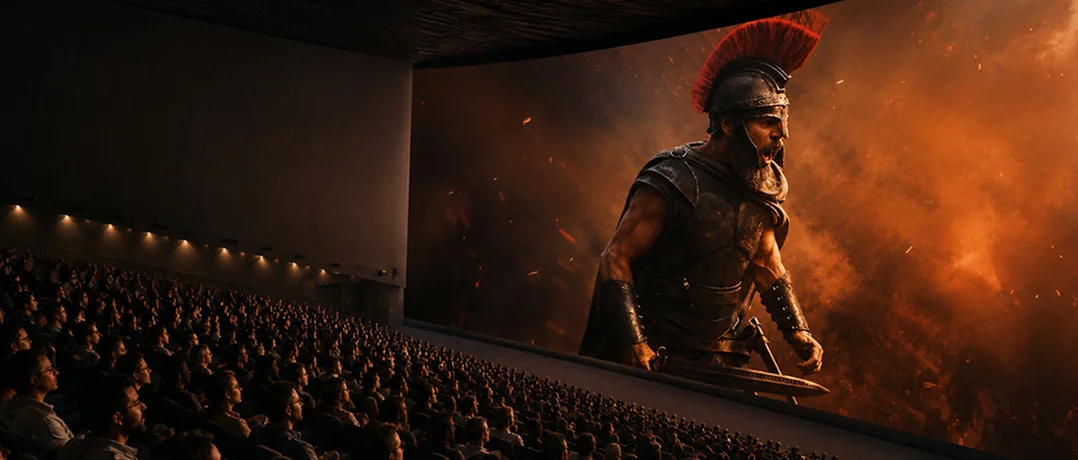
Christopher Nolan's The Odyssey has become a cultural event and Lebanon, it turns out, is very much part of that story. The film has surpassed $650 million globally after just two weekends of release, landing 2026's biggest live-action opening weekend with a $263.7 million global launch and a 94 percent approval rating from critics on Rotten Tomatoes, tied for Nolan's best mark ever. Locally, the appetite has matched that global frenzy. Beirut audiences have been booking out shows well in advance, with IMAX screenings in particular becoming difficult tickets to secure, a pattern one local viewer described as taking nearly a week of trying just to land his preferred seat.
A critic's verdict
For Josephine Habchi, film critic and writer, the experience of watching The Odyssey left a genuinely divided impression. "I came away from watching Christopher Nolan's The Odyssey with a double impression," she told The Beiruter. "On the one hand, I was watching a film that knows exactly how to astonish; on the other, one question stayed with me: Did I watch Homer's Odyssey, or Nolan's Odyssey?"
Habchi did not dispute Nolan's command of scale. "The sea, the battles, the monsters, the islands, the world of gods and mythology, and the use of IMAX photography all give the film an enormous visual scale. He knows how to turn an image into an event, and how to make cinema itself part of the story." But beneath the spectacle, she found herself searching for something the film only partially delivers. "Odysseus in Homer is not an ideal hero. He is intelligent, cunning and arrogant, capable of deception and cruelty, and full of contradictions. Nolan's Odysseus, by contrast, is closer to a contemporary hero, a man exhausted by war, haunted by guilt, trying to find his way back home and back to himself."
That interpretive choice, she argued, comes at a cost. "I understand this interpretation, and I find it intelligent, but I felt that Nolan tamed the character to some extent. He preserved his human wounds, but softened some of his cunning, moral ambiguity and danger." She pointed out an irony rarely acknowledged in adaptations of ancient texts, "The irony is that Homer, thousands of years ago, was more daring in certain details than the film itself. The original text is more satirical, more sensual and more deceptive, and more willing to embrace the grey area in which the hero is neither entirely good nor entirely evil."
Dialogue, for Habchi, was the film's weakest link. "At times, it feels as though Nolan the director surpasses Nolan the writer, the imagery is astonishing, but some of the characters and dialogue lack the depth that material this rich deserves." And yet, she resists reducing the film to a simple faithfulness test. "I do not want to ask only: Was the film faithful to Homer? The more important question is: What can The Odyssey mean to a man living in our time?" Her final assessment landed somewhere between admiration and reservation, "The Odyssey is a great film as 'cinema,' and perhaps a less great film as a 'reading of Homer.' But ultimately, it possesses one essential virtue, it does not simply reproduce the myth; it dares to reinvent it. And that daring, despite my reservations, is what makes the film most worthy of discussion."
What Beirut audiences are saying
Beyond critical assessment, three Lebanese viewers offered their own take after watching the film in theaters.
For Leil, anticipation had been building for over a year. "First, it's a Christopher Nolan film. Second, it was made for IMAX. And third, the story itself the mythology of The Odyssey and Greek mythology in general, is something I'm personally very interested in." Securing tickets proved a challenge in itself, "It took me about a week to finally get the ticket and seat I wanted." His verdict on the film was firmly positive. "I don't think it's overrated... Even though the movie runs for more than three hours, it doesn't feel that long. It keeps you hooked and excited throughout." He singled out the film's thematic weight, particularly its treatment of hospitality and the Sirens sequence, as what elevated it beyond spectacle. "It says a lot about what is truly significant and meaningful in life, and how some things ultimately matter more than our personal ambitions."
Atallah's reaction centered on craft, describing the film as "a visual triumph that sometimes overwhelms." "The cinematography is breathtaking, with every frame carrying an incredible sense of scale, while the editing is arguably one of the film's greatest strengths." But the immersion had its limits. "Some sequences are simply too loud, reaching a point where the sound becomes more annoying than immersive... There is also so much story to explore that certain aspects feel underserved."
Zbeidy's appreciation focused less on scale and more on Nolan's commitment to physical filmmaking in an era increasingly reliant on digital effects. "In the midst of the rise of AI, you would think a fictional movie like this would be heavily reliant on CGI and AI. But Nolan did the complete opposite," they said, pointing to the practically built Cyclops, animatronic transformations, and even actors buried in sand with snorkels to achieve the film's rising-dead sequence. "There's something about seeing, touching, and physically experiencing the world of a story that technology simply can't replicate. And when the actors can feel that authenticity, the audience feels it too."
A cinematic experience
Between a critic wrestling with questions of fidelity and meaning, and audiences packing IMAX screenings well past midnight for a chance to see it, The Odyssey has clearly found its footing in Lebanon, not despite its ambition and length, but largely because of it. Whether viewed as Homer's epic or Nolan's reinvention of it, the film has done what few releases manage anymore, turned a trip to the cinema back into an event worth waiting a week in line for.
-
-

-
The Beiruter
-
